
Profile of a DVRHS Graduate

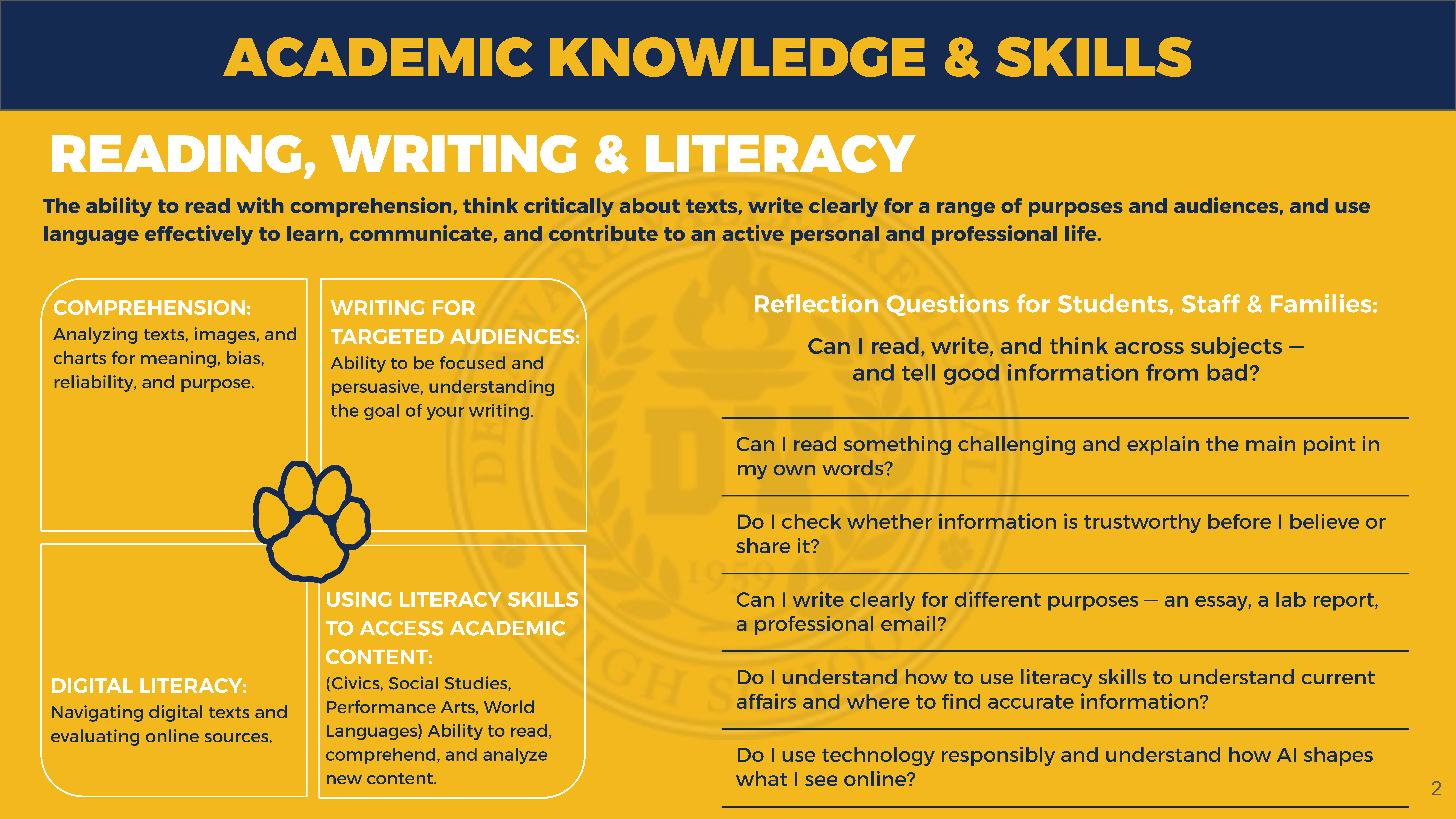
ACADEMIC KNOWLEDGE & SKILLS - READING, WRITING & LITERACY : The ability to read with comprehension, think critically about texts, write clearly for a range of purposes and audiences, and use language effectively to learn, communicate, and contribute to an active personal and professional life. Reflection Questions for Students, Staff & Families: Can I read something challenging and explain the main point in my own words? Do I check whether information is trustworthy before I believe or share it? Can I write clearly for different purposes — an essay, a lab report, a professional email? Do I understand how to use literacy skills to understand current affairs and where to find accurate information? Do I use technology responsibly and understand how AI shapes what I see online? Can I read, write, and think across subjects — and tell good information from bad? Comprehension: Analyzing texts, images, and charts for meaning, bias, reliability, and purpose. Writing for Targeted Audiences: Ability to be focused and persuaive, understanding the goal of your writing. Digital Literacy: Navigating digital texts and evaluating online sources. Using Literacy Skills to Access Academic Content: (Civics, Social Studies, Performance Arts, World Languages): Ability to read, comprehend, and analyze new content.
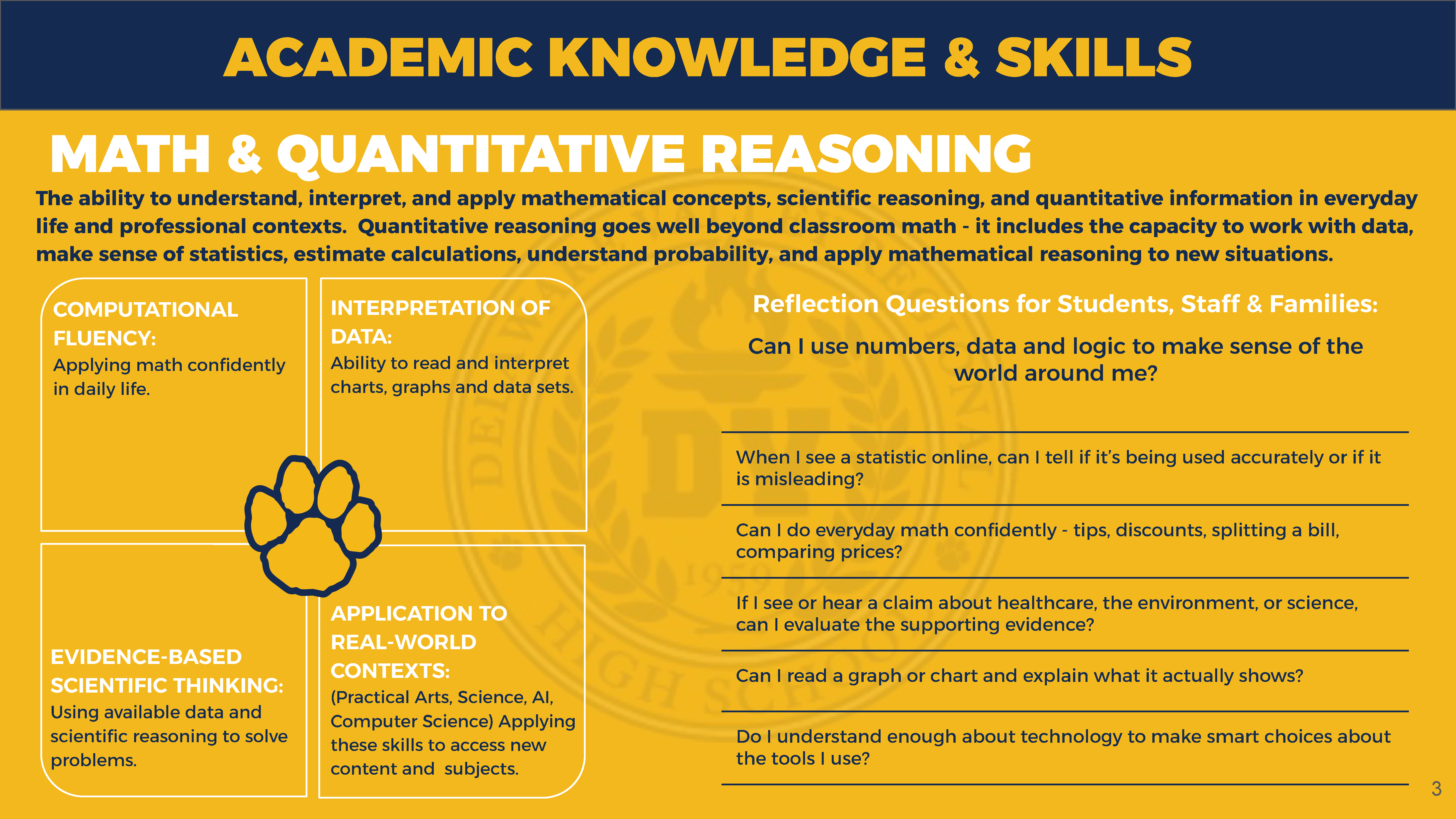
ACADEMIC KNOWLEDGE & SKILLS - MATH & QUANTITATIVE REASONING: The ability to understand, interpret, and apply mathematical concepts, scientific reasoning, and quantitative information in everyday life and professional contexts. Quantitative reasoning goes well beyond classroom math - it includes the capacity to work with data, make sense of statistics, estimate calculations, understand probability, and apply mathematical reasoning to new situations. Reflection Questions for Students, Staff & Families: When I see a statistic online, can I tell if it's being used accurately or if it is misleading? Can I do everyday math confidently - tips, discounts, splitting a bill, comparing prices? If I see or hear a claim about healthcare, the environment, or science, can I evaluate the supporting evidence? Can I read a graph or chart and explain what it actually shows? Do I understand enough about technology to make smart choices about the tools I use? Can I use numbers, data and logic to make sense of the world around me? Comprehension: Applying math confidently in daily life. Interpretation of Data: Ability to read and interpret charts, graphs, and data sets. Evidence-based Scientific Thinking: Using available data and scientific reasoning to solve problems. Application to Real-World Contexts: (Practical Arts, Science, AI, Computer Science) Applying these skills to access new content and subjects.
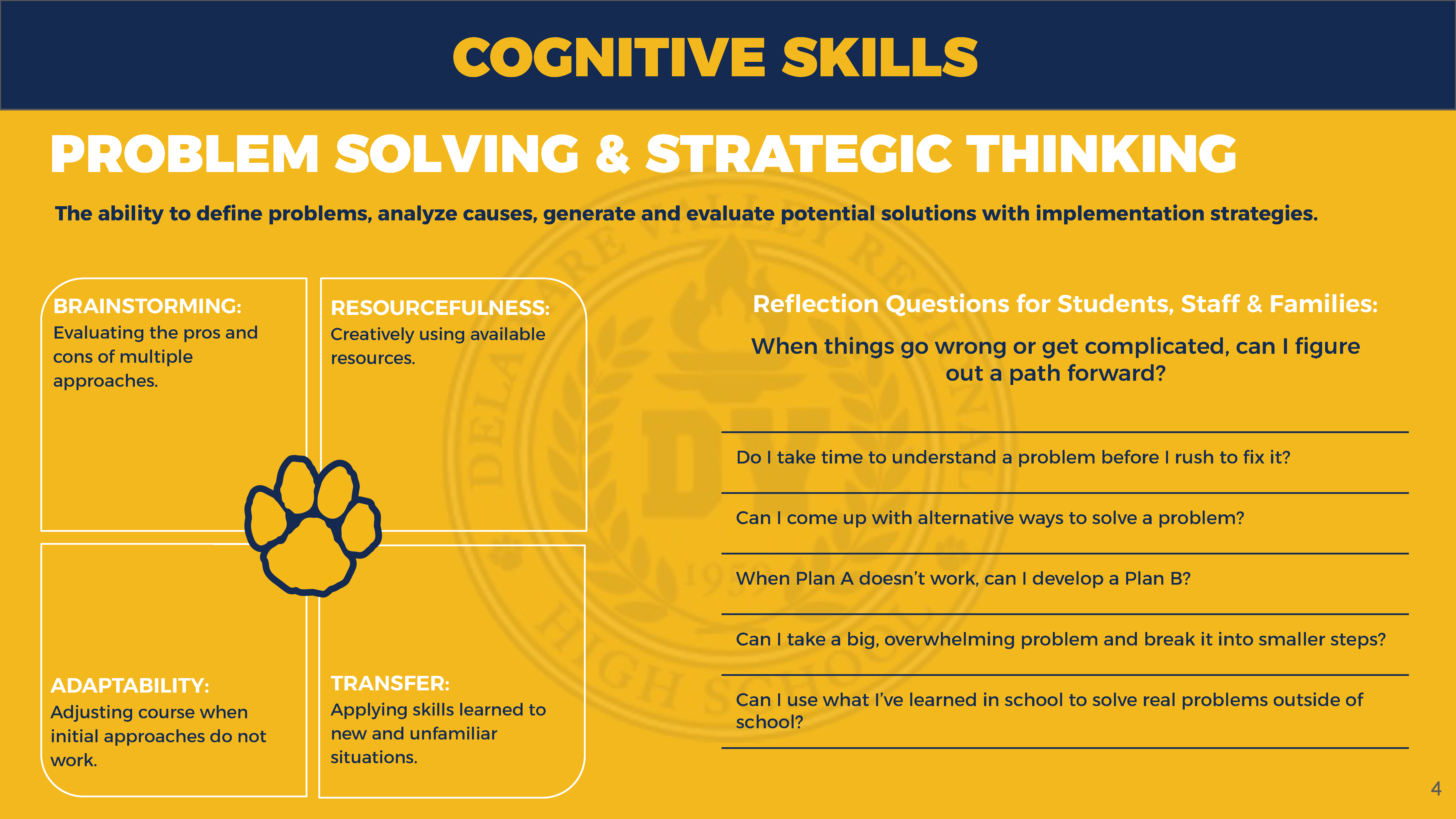
COGNITIVE SKILLS - PROBLEM SOLVING & STRATEGIC THINKING: The ability to define problems, analyze causes, generate and evaluate potential solutions with implementation strategies. Reflection Questions for Students, Staff & Families: Do I take time to understand a problem before I rush to fix it? Can I come up with alternative ways to solve a problem? When Plan A doesn't work, can I develop a Plan B? Can I take a big, overwhelming problem and break it into smaller steps? Can I use what I've learned in school to solve real problems outside of school? When things go wrong or get complicated, can I figure out a path forward? Brainstorming: Evaluating the pros and cons of multiple approaches. Resourcefulness: Creatively using available resources. Adaptability: Adjusting course when initial approaches do not work. Transfer: Applying skills learned to new and unfamiliar situations.
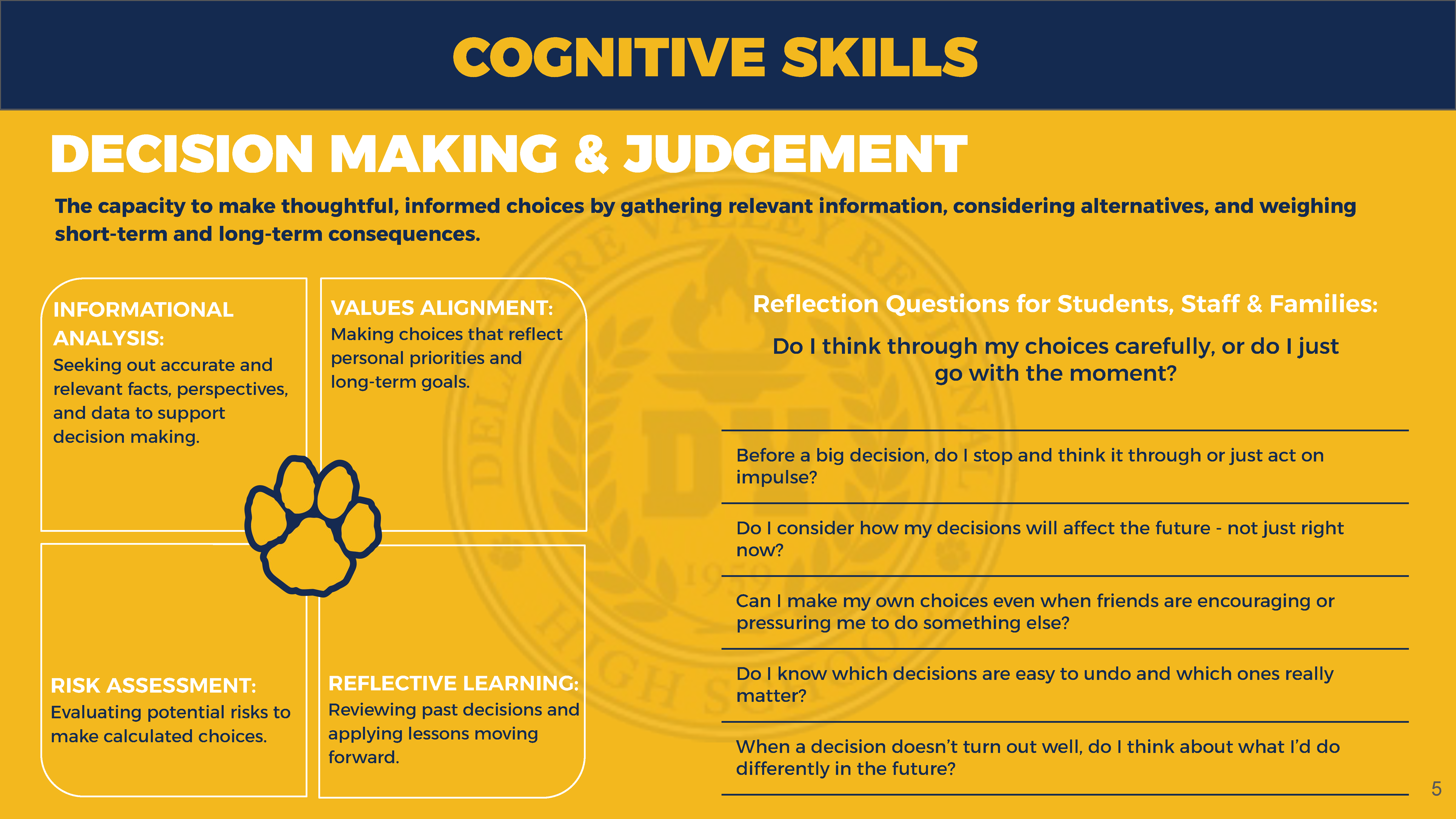
COGNITIVE SKILLS - DECISION MAKING & JUDGEMENT: The capacity to make thoughtful, informed choices by gathering relevant information, considering alternatives, and weighing short-term and long-term consequences. Reflection Questions for Students, Staff & Families: Before a big decision, do I stop and think it through or just act on impulse? Do I consider how my decisions will affect the future - not just right now? Can I make my own choices even when friends are encouraging or pressuring me to do something else? Do I know which decisions are easy to undo and which ones really matter? When a decision doesn't turn out well, do I think about what I'd do differently in the future? Do I think through my choices carefully, or do I just go with the moment? Informational Analysis: Seeking out accuarte and relevant facts, perspectives, and data to support decision making. Values Alignment: Making choices that reflect personal priorities and long-term goals. Risk Assessment: Evaluating potential risks to make calculated choices. Reflective Learning: Reviewing past decisions and applying lessons moving forward.
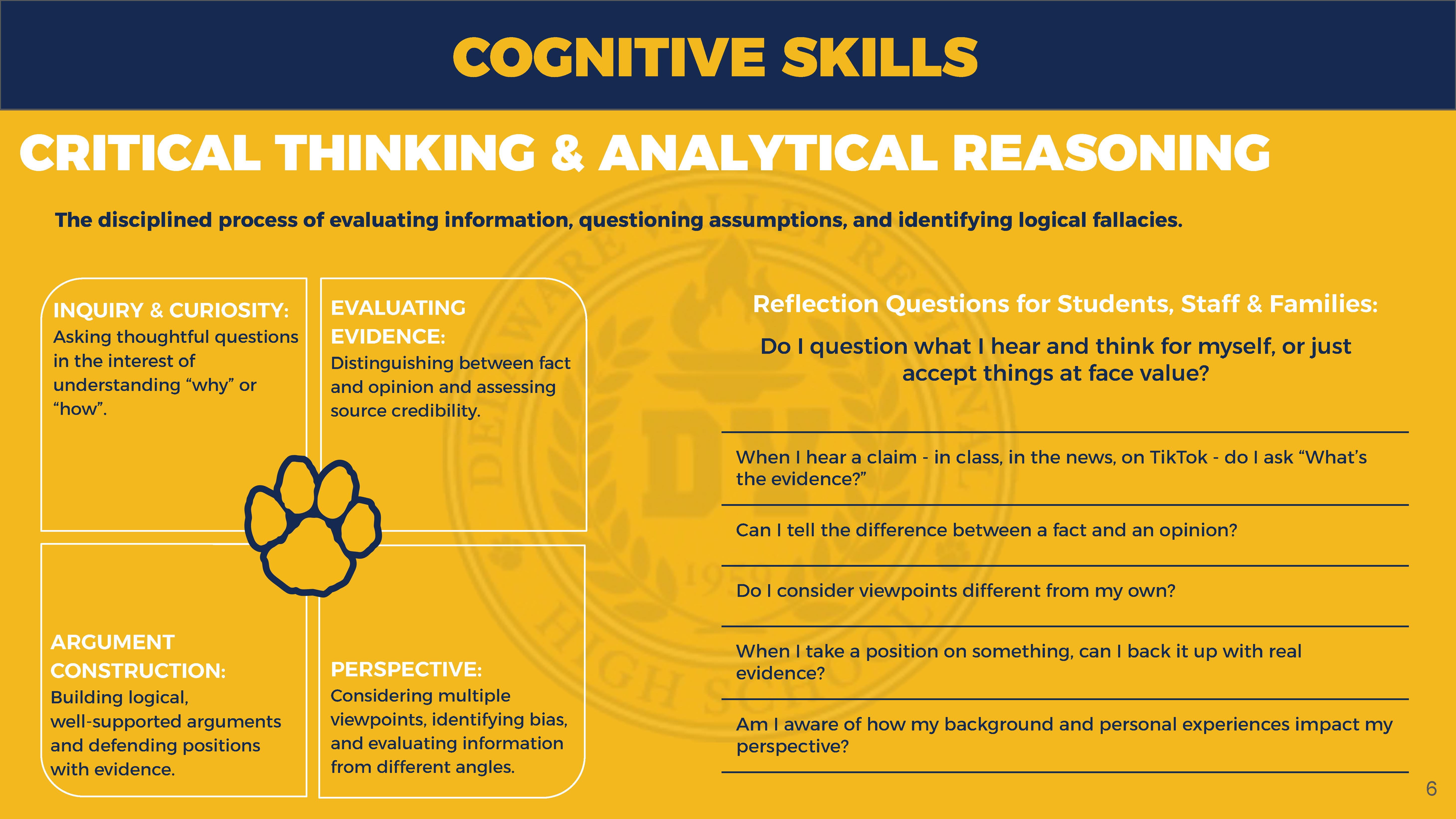
COGNITIVE SKILLS - CRITICAL THINKING & ANALYTICAL REASONING: The disciplined process of evaluating information, questioning assumptions, and identifying logical fallacies. Reflection Questions for Students, Staff & Families: When I hear a claim - in class, in the news, on TikTok - do I ask "What's the evidence?" Can I tell the difference between a fact and an opinion? Do I consider viewpoints different from my own? When I take a position on something, can I back it up with real evidence? Am I aware of how my background and personal experiences impact my perspective? Do I question what I hear and think for myself, or just accept things at face value? Inquiry. & Curiosity: Asking thoughtful questions in the interest of understanding "why" or "how". Evaluating Evidence: Distinguishing between facta nd opinion and assessing source credibility. Argument Construction: Building logical, well-supported arguments and defending positions with evidence. Perspective: Considering multiple viewpoints, identifying bias, and evaluating information from different angles.
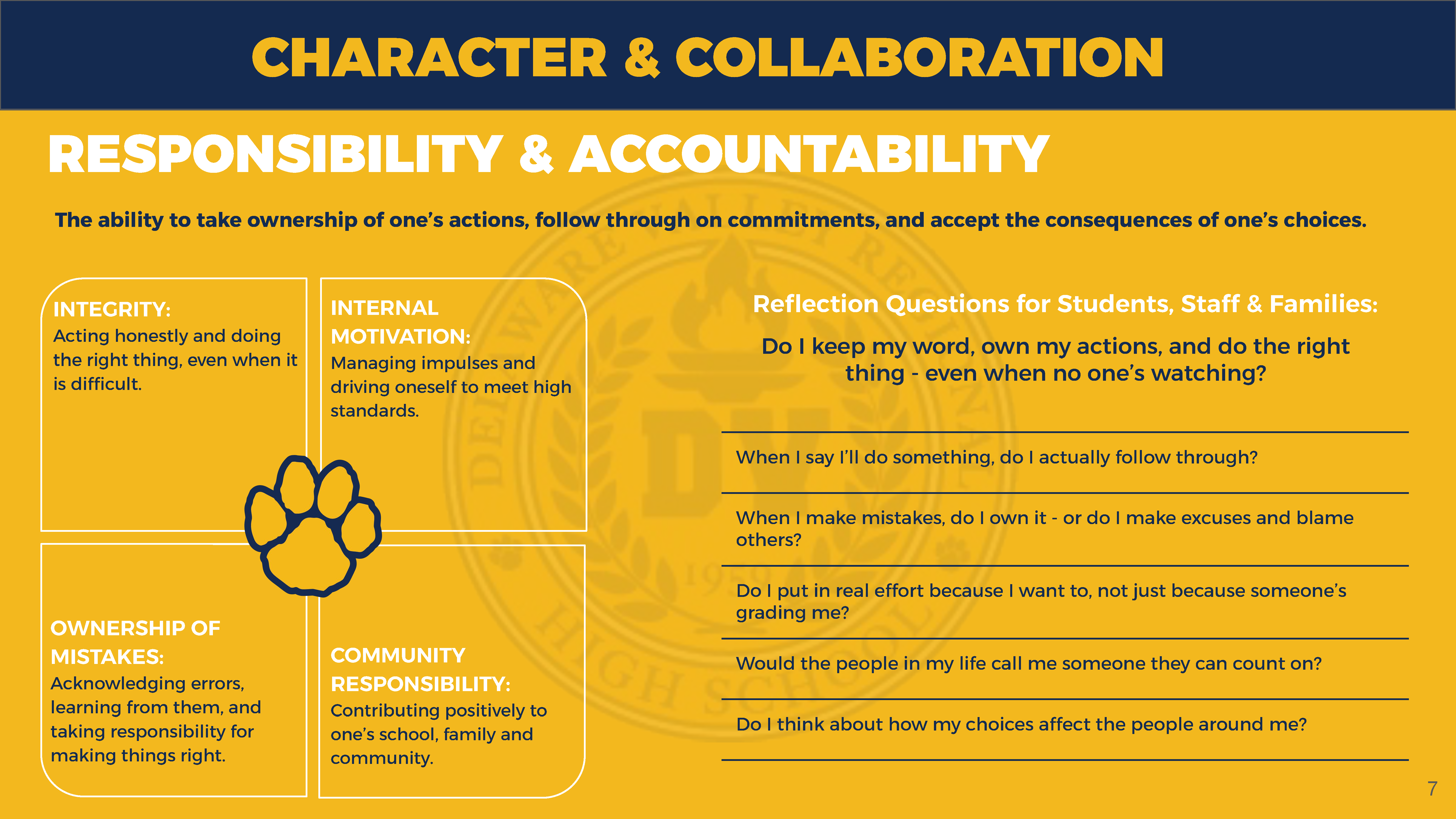
CHARACTER & COLLABORATION - RESPONSIBILITY & ACCOUNTABILITY: The ability to take ownership of one's actions, follow through on commitments, and accept the consequences of one's choices. Reflection Questions for Students, Staff & Families: When I say I'll do something, do I actually follow through? When I make mistakes, do I own it - or do I make excuses and blame others? Do I put in real effort because I want to, not just because someone's grading me? Would the people in my life call me someone they can count on? Do I think about how my choices affect the people around me? Do I keep my word, own my actions, and do the right thing - even when no one's watching? Integrity: Acting honestly and doing the right thing, even when it is difficult. Internal Motivation: Managing impulses and driving oneself to meet high standards. Ownership of Mistakes: Acknowledging errors, learning from them, and taking responsibility for making things right. Community Responsibility: Contributing positively to one's school, family, and community.
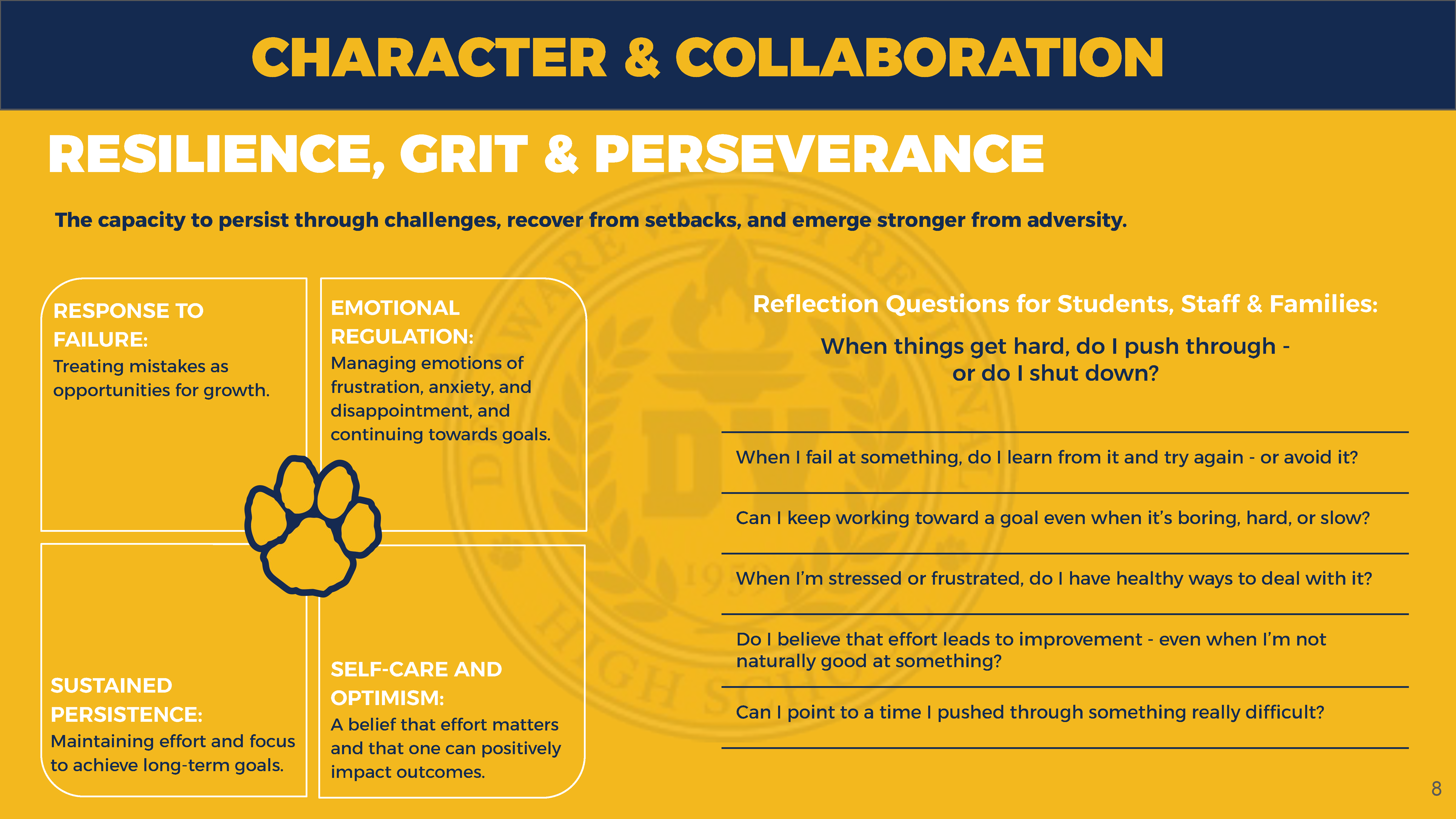
CHARACTER & COLLABORATION - RESILIENCE, GRIT & PERSEVERANCE: The capacity to persist through challenges, recover from setbacks, and emerge stronger from adversity. Reflection Questions for Students, Staff & Families: When I fail at something, do I learn from it and try again - or avoid it? Can I keep working toward a goal even when it's boring, hard, or slow? When I'm stressed or frustrated, do I have healthy ways to deal with it? Do I believe that effort leads to improvement - even when I'm not naturally good at something? Can I point to a time I pushed through something really difficult? When things get hard, do I push through - or do I shut down? Response to Failure: Treating mistakes as opportunities for growth. Emotional Regulation: Managing emotions of frustration, anxiety, and disappointment, and continuing towards goals.
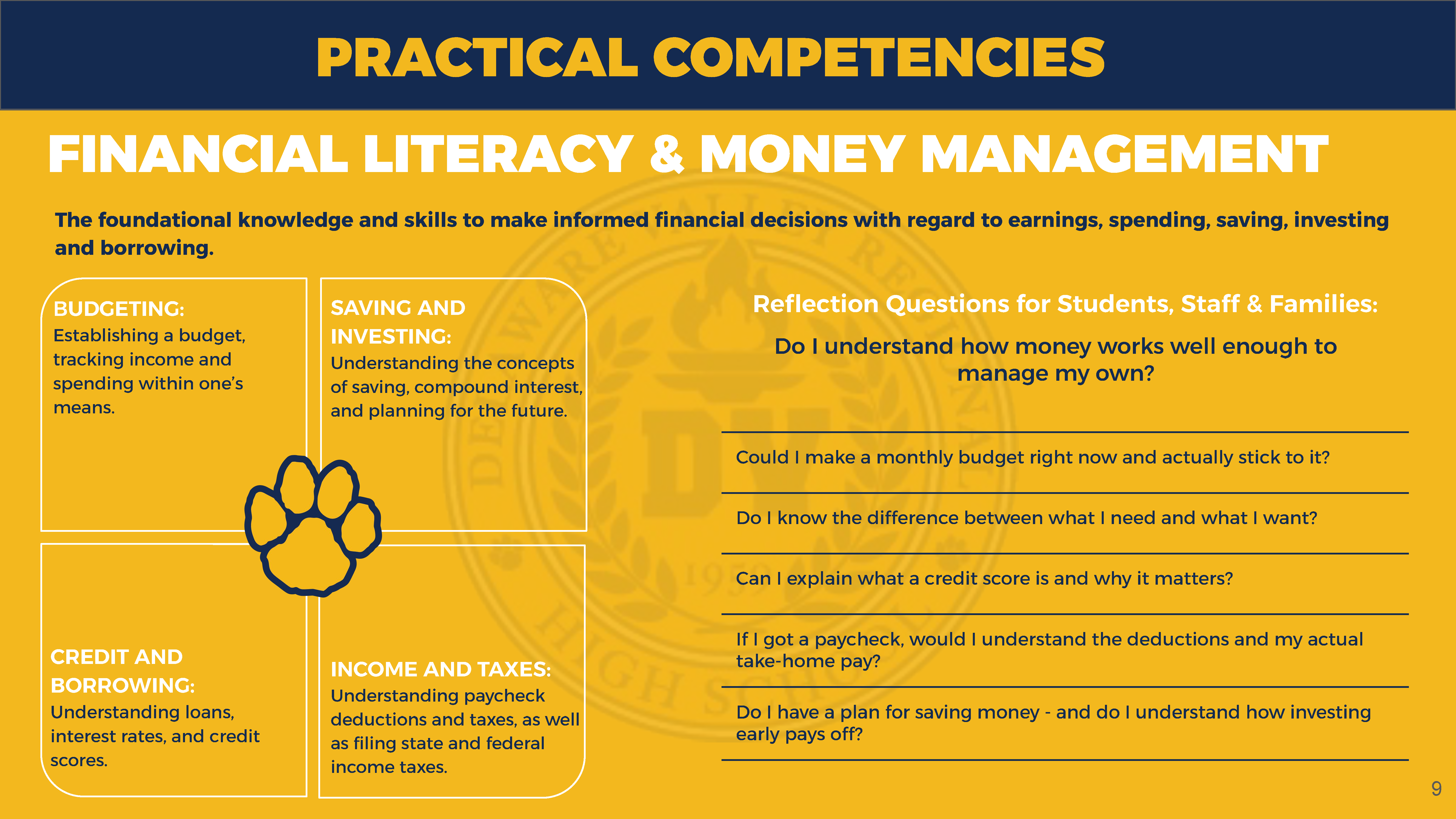
PRACTICAL COMPETENCIES - FINANCIAL LITERACY & MONEY MANAGEMENT: The foundational knowledge and skills to make informed financial decisions with regard to earnings, spending, saving, investing and borrowing. Reflection Questions for Students, Staff & Families: Could I make a monthly budget right now and actually stick to it? Do I know the difference between what I need and what I want? Can I explain what a credit score is and why it matters? If I got a paycheck, would I understand the deductions and my actual take-home pay? Do I have a plan for saving money - and do I understand how investing early pays off? Do I understand how money works well enough to manage my own? Budgeting: Establishing a budget, tracking income and spending within one's means. Saving and Investing: Understanding the concepts of saving, compound interest, and planning for the future. Credit and Borrowing: Understanding loans, interest rates, and credit scores. Income and Taxes: Understanding paycheck deductions and taxes as well as filing state and federal income taxes.
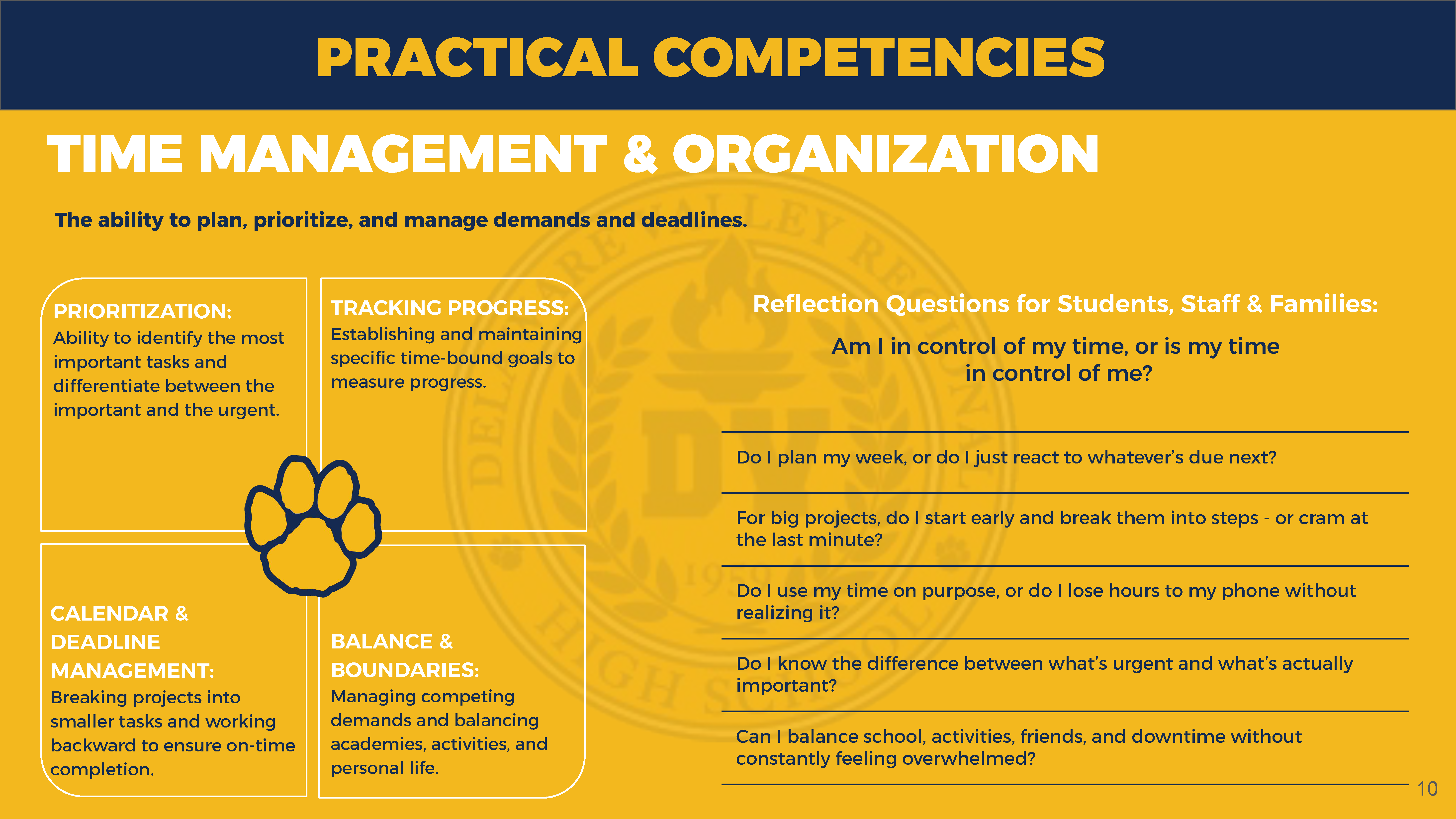
PRACTICAL COMPETENCIES - TIME MANAGEMENT & ORGANIZATION: The ability to plan, prioritize, and manage demands and deadlines. Reflection Questions for Students, Staff & Families: Do I plan my week, or do I just react to whatever's due next? For big projects, do I start early and break them into steps - or cram at the last minute? Do I use my time on purpose, or do I lose hours to my phone without realizing it? Do I know the difference between what's urgent and what's actually important? Can I balance school, activities, friends, and downtime without constantly feeling overwhelmed? Am I in control of my time, or is my time in control of me? Prioritization: Ability to identify the most important tasks and differentiate between the important and the urgent. Tracking Progress: Establishing and maintaining specific time-bound goals to measure progress. Calendar & Deadline Management: Breaking projects into smaller tasks and working backward to ensure on-time completion. Balance & Boundaries: Managing competing demands and balancing academies, activities, and personal life.
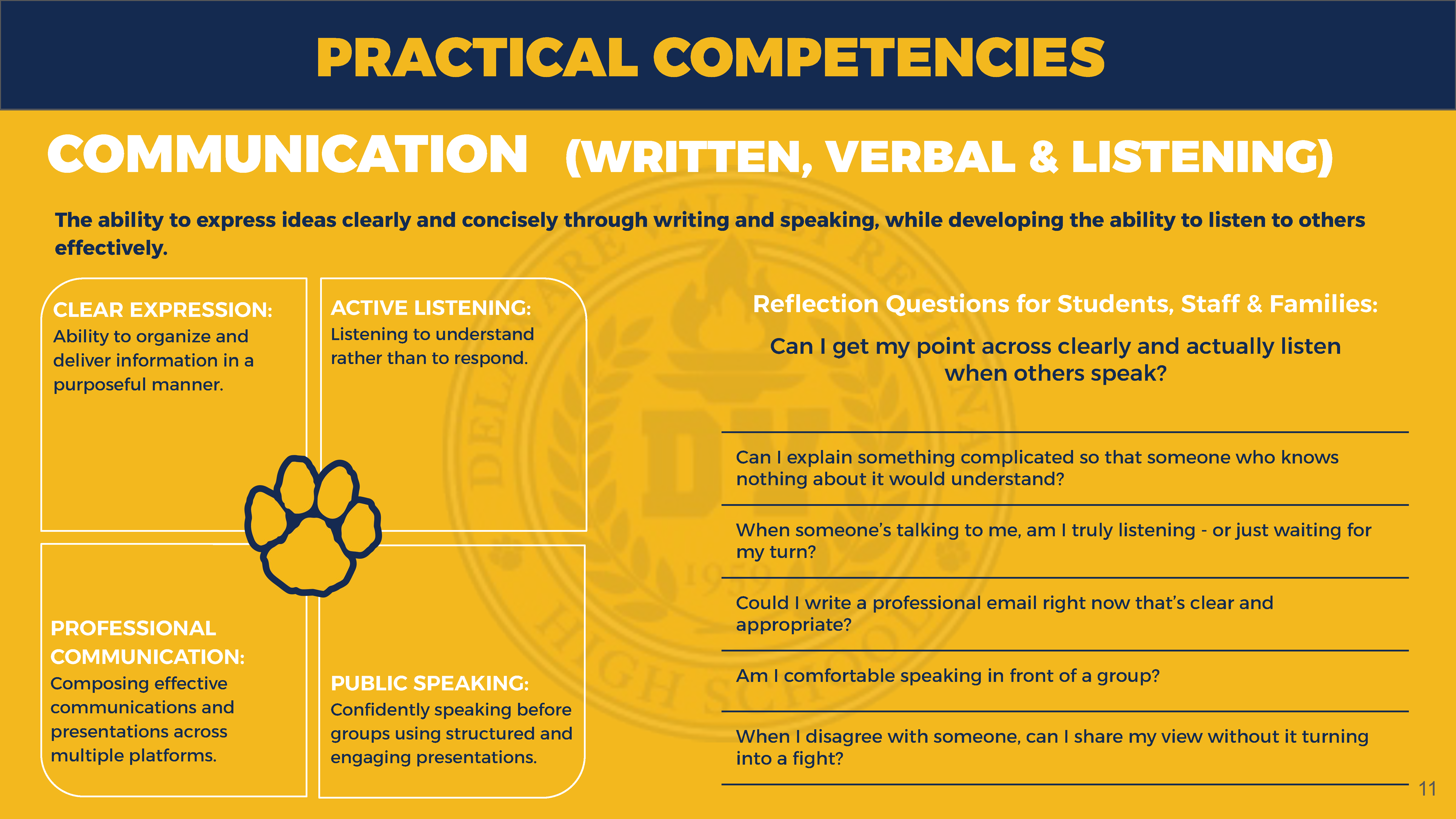
PRACTICAL COMPETENCIES -COMMUNICATION (WRITTEN, VERBAL & LISTENING): The ability to express ideas clearly and concisely through writing and speaking, while developing the ability to listen to others effectively. Reflection Questions for Students, Staff & Families: Can I explain something complicated so that someone who knows nothing about it would understand? When someone's talking to me, am I truly listening - or just waiting for my turn? Could I write a professional email right now that's clear and appropriate? Am I comfortable speaking in front of a group? When I disagree with someone, can I share my view without it turning into a fight? Can I get my point across clearly and actually listen when others speak? Clear Expression: Ability to organize and deliver information in a purposeful manner. Active Listening: Listening to understand rather than to respond. Professional Communication: Composing effective communications and presentations across multiple platforms. Public Speaking: Confidently speaking before groups using structured and engaging presentations.